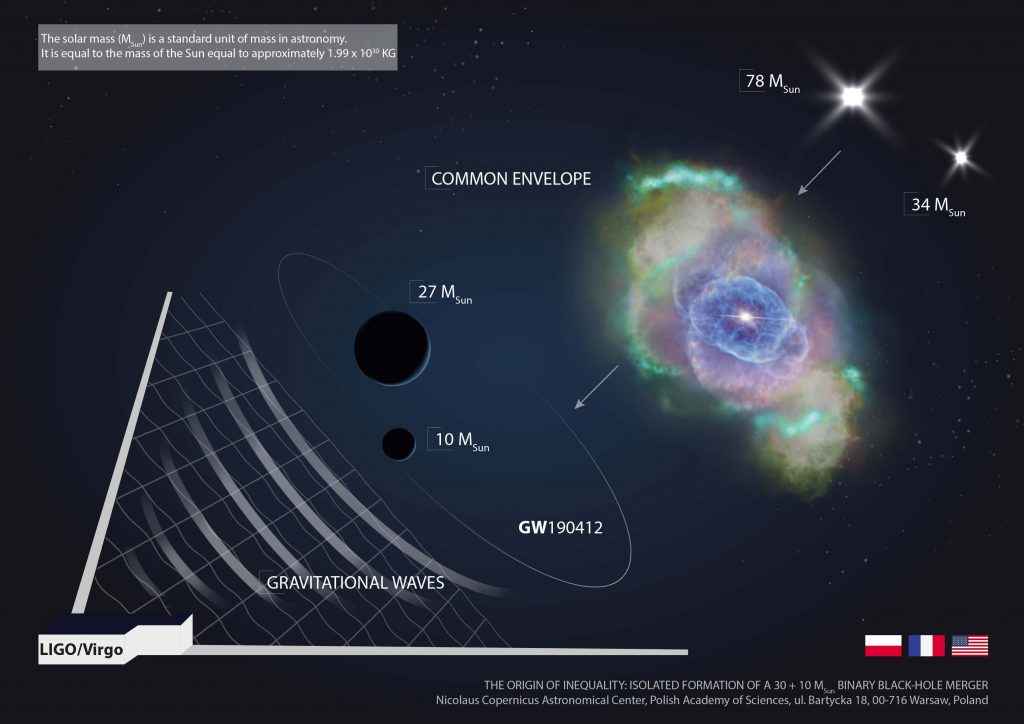
“The LIGO/Virgo Collaboration has reported the detection of GW190412, a black hole–black hole (BH–BH) merger with the most unequal masses to date. [..] They are m 1 = 24.4–34.7 Msun and m 2 = 7.4–10.1 Msun, corresponding to a mass ratio of q = 0.21–0.41 (90% probability range). Additionally, GW190412’s effective spin was estimated to be χ eff = 0.14–0.34, with the spin of the primary BH in the range a spin = 0.17–0.59. Based on this and prior detections,  10% of BH–BH mergers have q
  0.4. Major BH–BH formation channels (i.e., dynamics in dense stellar systems, classical isolated binary evolution, or chemically homogeneous evolution) tend to produce BH–BH mergers with comparable masses (typically with q 0.5). Here we test whether the classical isolated binary evolution channel can produce mergers resembling GW190412. We show that our standard binary evolution scenario, with the typical assumptions on input physics that we have used in the past, produces such mergers […]. The results from our standard model are consistent with the masses and spins of the black holes in GW190412, as well as with the LIGO/Virgo estimate of the fraction of unequal-mass BH–BH mergers. As GW190412 shows some weak evidence for misaligned spins, we provide distribution of the precession parameter in our models and conclude that if among the new LIGO/Virgo detections the evidence of system precession is strong and more than 10% of BH–BH mergers have large in-plane spin components (χ p > 0.5), then the common envelope isolated binary BH–BH formation channel can be excluded as their origin”
The Origin of Inequality: Isolated Formation of a 30+10 M ⊙ Binary Black Hole Merger Olejak, A.; Fischbach, M.; Belczynski, K. et al. 2020 ApJL 901 L39