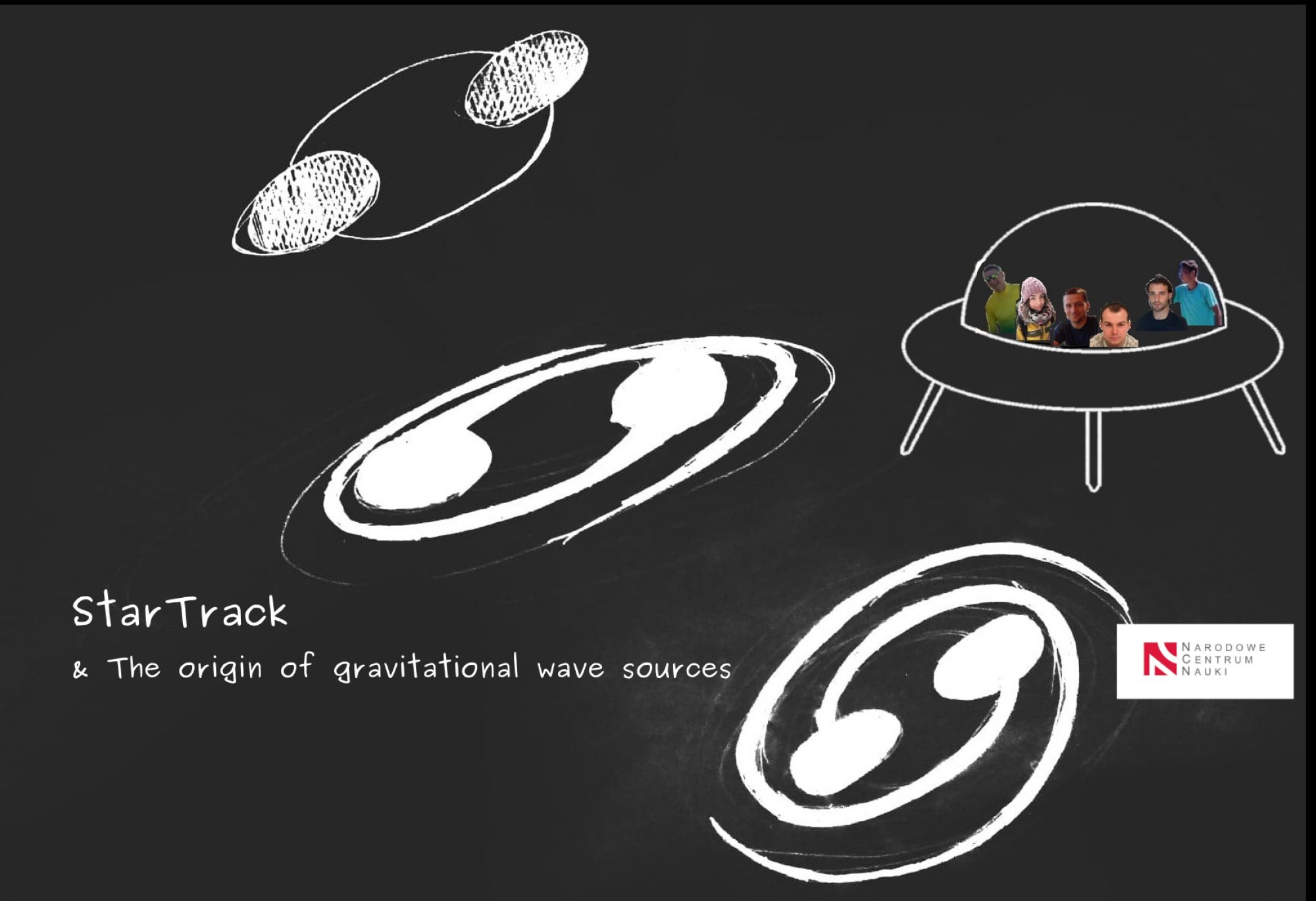
Gravitational wave sources: Advancements in stellar evolution modeling of binary black hole progenitors – PhD defended!

During his PhD, Amedeo Romagnolo investigated the evolutionary history of binary black holes, the primary sources of detectable gravitational waves. The research focused on the massive stars that served as the progenitors for these cosmic mergers, addressing the significant uncertainties that currently persist in stellar evolution modeling. Because massive binary systems are both rare and short-lived, capturing their complex physical transitions—from their initial formation to their eventual collapse—remains a significant challenge in the field.

A central contribution of this work involved refining how stellar expansion couples with mass transfer events, a critical factor in determining whether a binary system eventually forms a merging black hole pair. By analyzing these interactions, the research demonstrated that the timing and stability of mass exchange are fundamental to the final architecture of gravitational wave sources. Furthermore, the study re-evaluated the role of stellar winds and their contribution to our knowledge of black hole masses. A key finding revealed that the most massive stars in the local universe do not expand significantly during their evolution, a discovery that challenges traditional assumptions about stellar growth. By providing a clearer link between these internal physical processes and the signals detected by modern observatories, this research advanced the broader understanding of how the fundamental properties of stars dictate the population of black hole mergers within our universe.
New Publication: Spin Symmetry Breaking in Merging Binary Black Holes

A new paper from Sambaran Banerjee, Aleksandra Olejak, and Krzysztof Belczyński asks whether the mild preference for aligned spins seen in LIGO/Virgo’s catalogue of binary black hole mergers can help us distinguish between formation in isolated field binaries versus dynamical assembly in young massive star clusters. The spin alignment of merging black holes had previously been proposed as a way to favour the isolated binary channel, since field binaries might retain a memory of their shared orbital history in their spins, while cluster-assembled pairs would not.

The paper shows that this distinction is less clean than assumed. Young massive clusters also produce a spin alignment asymmetry, because many of the merging pairs within them were originally born as binary stars and retain partial alignment despite subsequent dynamical perturbations. Both channels, combined with realistic natal kick distributions, reproduce the observed spin alignment distribution. Disentangling the two will require more precise measurements from future gravitational wave observations rather than spin alignment alone. StarTrack population synthesis, with Universe@Home providing part of the computational support, underpins the isolated binary component of the analysis.

Link to paper: https://arxiv.org/abs/2302.10851

Life beyond us

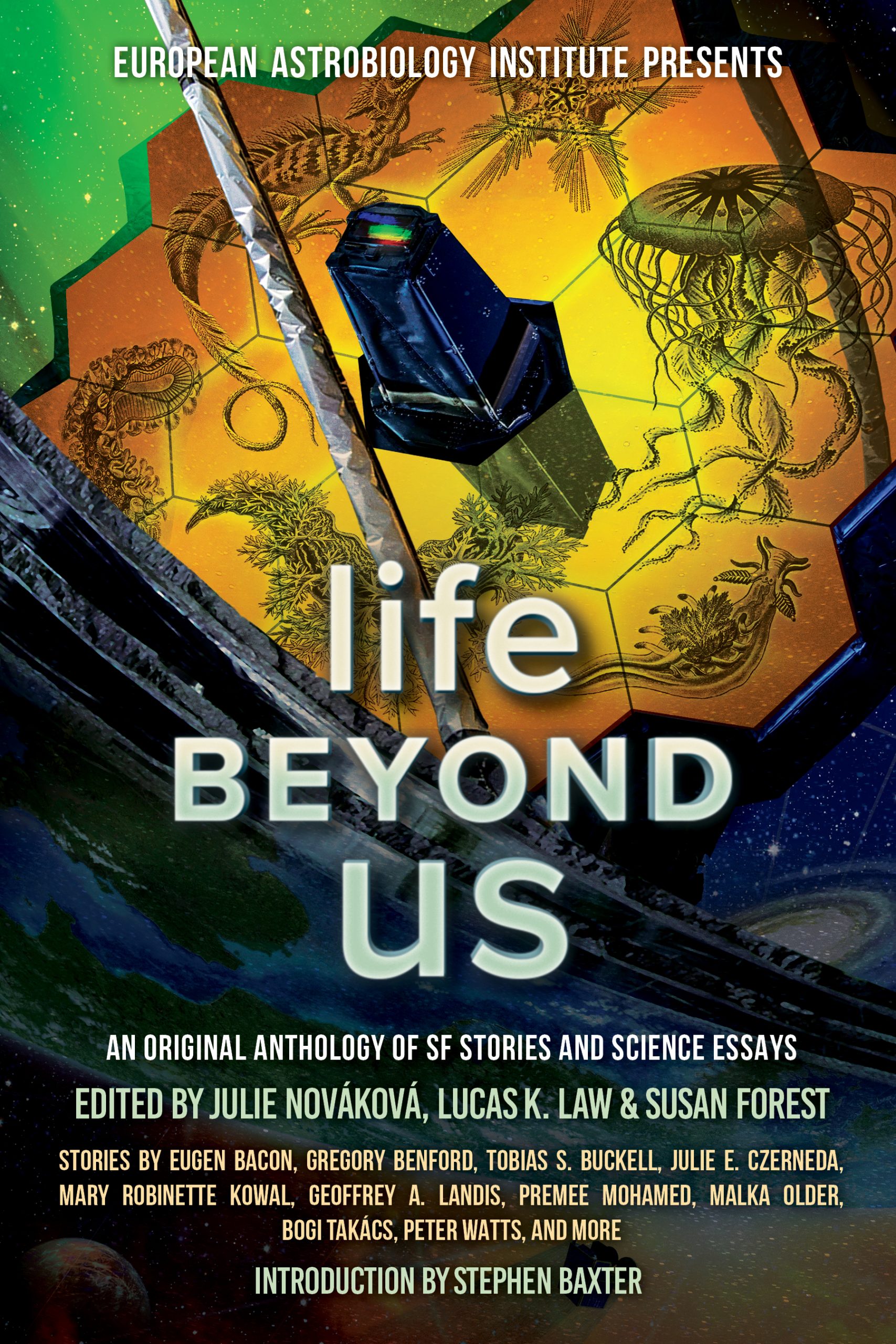
Amedeo took part in the creation of the anthology of Sci-fi stories focused on extratterestrial life! Within a consortium of novel writers and researchers, each of these stories were accompanied by an outreach essay to explain the underlying science behind their creation. Amedeo contributed to the construction of these stories, as well as delivering an outreach essay to explain the current state of knowledge of planetary formation around neutron stars and black holes, as well as the potential sources of energy that can lead to the formation of life forms on these unusual planets.

More info here: https://europeanastrobiology.eu/life-beyond-us/

Ripples in Spacetime

Since 2016, when the first gravitational wave detection was announced (signal GW150914, originating from the merger of two black holes with masses of ~29 and ~36 solar masses), astrophysics has opened a completely new window for observing the cosmos. Gravitational waves – predicted over 100 years ago by Einstein as an effect of his general theory of relativity – are subtle disturbances in the very fabric of spacetime, now detectable with a precision of about 1/10,000 the width of a proton by the LIGO and Virgo detectors.

To date, around 90 such signals have been recorded, dominated by merging binary black hole systems. This data provides invaluable information about the evolution of massive stars, the mechanisms behind the formation of black holes and neutron stars, and even the origin of heavy elements such as gold and platinum.

The mechanisms leading to the formation of such compact binary systems are not yet fully understood. One of the leading scenarios involves the isolated evolution of massive binary star systems – precisely the topic investigated by the research group at CAMK PAN led by Prof. Krzysztof Belczynski.

This is only the beginning. Next-generation detectors – the Einstein Telescope and Cosmic Explorer – are expected to capture signals from the early stages of the Universe’s expansion, opening up the prospect of testing theories about its evolution and the history of star formation.

Link to article: https://journals.pan.pl/Content/124728/PDF/66-68_Olejak_pol.pdf

Black Hole Swallows Neutron Star — Seen for the First Time

For decades, astronomers predicted that black holes and neutron stars should collide. We knew they existed in binary systems, we knew their orbits decay over time, and we knew that eventually — inevitably — they would merge. Yet no one had ever directly observed such an event. Until now.

LIGO and Virgo detectors have reported the first confirmed detections of gravitational waves from black hole–neutron star mergers. Two such events, detected within ten days of each other, finally confirmed what stellar evolution models had long anticipated. Prof. Krzysztof Belczyński from the Nicolaus Copernicus Astronomical Center in Warsaw is among those who predicted these collisions over a decade ago — and his models appear to be holding up.

The events themselves, however, delivered a somewhat sobering message for astronomers hoping to see a full light show. In the most exciting scenario, the neutron star would be torn apart outside the black hole’s event horizon, flinging neutron-rich matter into space and producing a brilliant burst of electromagnetic radiation — a kilonova visible across the spectrum. Instead, both neutron stars appear to have been swallowed whole, crossing the event horizon before being disrupted. No electromagnetic counterpart was detected. Gravitational waves only.

This outcome is consistent with Belczyński’s earlier predictions: the black holes involved rotate too slowly, giving them large event horizons that engulf the neutron star before it can be shredded. The models suggest only a few to perhaps twenty percent of such mergers might produce detectable light.

With LIGO preparing for its next observing run, the number of detected neutron star–black hole mergers is expected to grow rapidly. More events mean sharper tests of our models — and perhaps, eventually, the electromagnetic fireworks astronomers are still waiting for.

Link to video: https://www.youtube.com/watch?v=Yi3f8hRYB7o

Two Monsters on the Invisible Sky

Black holes, by definition, are invisible. Until the first one was discovered in constellation of Cygnus about 50 years ago. If a black hole exists alone it is truly invisible, as it does not emit any electromagnetic radiation. However, if black hole happens to have a close companion, say a star like our Sun, it will swallow companion matter/atoms into its center. This creates a visible signature, as such atoms falling into black hole emit X-rays that we can detect. About 50 such binary systems are known (black hole + stellar companion) with black holes weighting typically about 10 times more than the Sun.

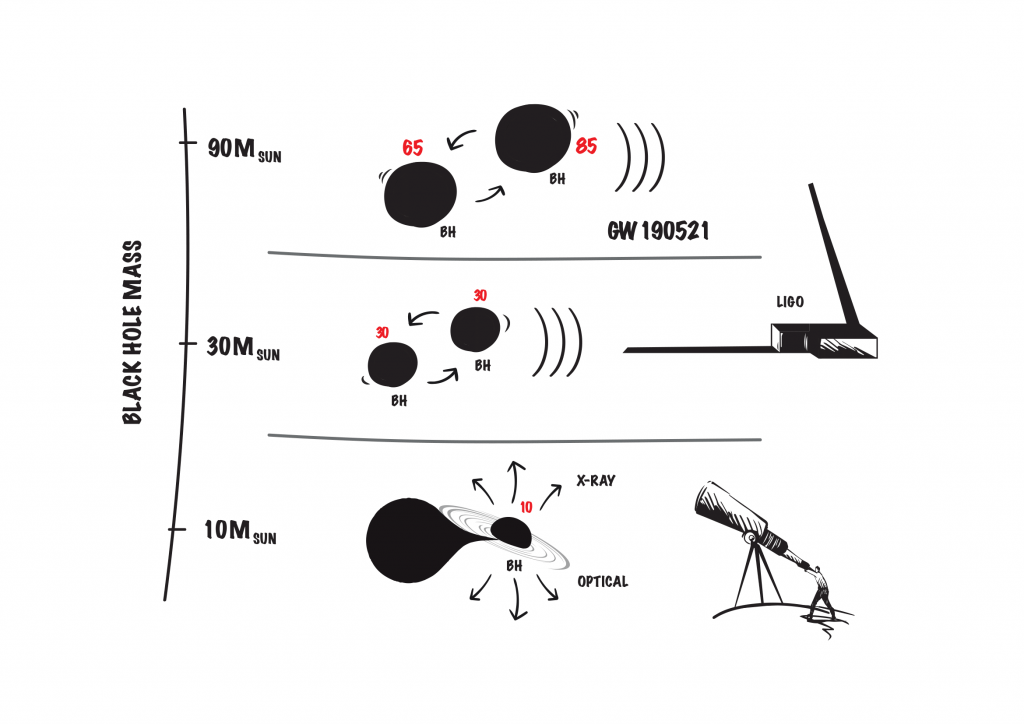
About 5 years ago another way that does not involve electromagnetic radiation (light, X-rays, infrared…) of probing the cosmos has opened. American observatory LIGO has detected collision of two black holes in gravitational-waves. Gravitational-waves vibrate through the fabric of space-time itself, changing (on a ridiculously microscopic scale) distances between objects. Yet changes that we can measure on Earth. Until today another 50 such collisions have been reported by LIGO with typical black hole masses of about 30 times of the mass of Sun (Msun). One of this collisions stands out: two black holes, one with mass of 66 Msun and one with mass of 85 Msun. Stellar evolutionary calculations, that follow life of stars and their deaths in which black holes are born, did not allow for the formation of black holes more massive than 50 Msun. Yet here we are!

It was believed that the largest stars that could have formed such massive black holes are totally disrupted in powerful supernova explosions leaving nothing behind but shells of expanding gas that used to be a star. The discovery prompted a very quick revision of stellar evolutionary calculations, in particular the amount of energy that is produced in nuclear fusion that power stars and the efficiency of mixing of elements in stellar interiors. These revisions allow potentially to increase the maximum mass of a black hole from 50 Msun to 90 Msun. Folded with specific evolution of binary systems of stars that form black hole collisions, Chris Belczynski has shown in his recent study that formation of a 66+85 Msun system, like the one detected by LIGO, is possible and can not be excluded. The binary star scenario adds to the growing pool of proposals that have been put forward to explain the formation of the most massive double black hole binary known to date.

Link to paper:
https://ui.adsabs.harvard.edu/abs/2020ApJ…905L..15B/abstract

History of black hole discoveries in pictures. Bottom panel: X-ray emitting binary system with typical black hole mass of ~10 Msun. Middle panel: typical BH-BH system detected by LIGO/Virgo instruments with both black hole masses of ~30 Msun. Top panel: The most massive detected double black hole binary GW190521 with black hole masses ~65Msun and ~85 Msun.

Universe@Home: Citizen Science Powering Our Research

Our group’s population synthesis simulations — the calculations behind our predictions for gravitational wave sources — require far more computing power than any single institution can provide. To bridge that gap, we initiated Universe@Home, a volunteer computing project run from CAMK PAN on the BOINC platform. Anyone with a spare computer can contribute: the BOINC client runs our binary evolution code in the background whenever the machine is idle, returning results to the project server automatically. Since launching in 2015 — as the first BOINC project ever hosted by a Polish scientific institution — Universe@Home has grown to nearly 30,000 participating computers worldwide.

The science running on these volunteer machines covers the full range of our group’s research interests: formation and merger rates of binary black holes and neutron stars, the origin of ultraluminous X-ray sources, and the construction of synthetic black hole population databases for the Milky Way.

If you would like to contribute, you can create a free account and join at https://universeathome.pl

Supernova that has formed a black hole

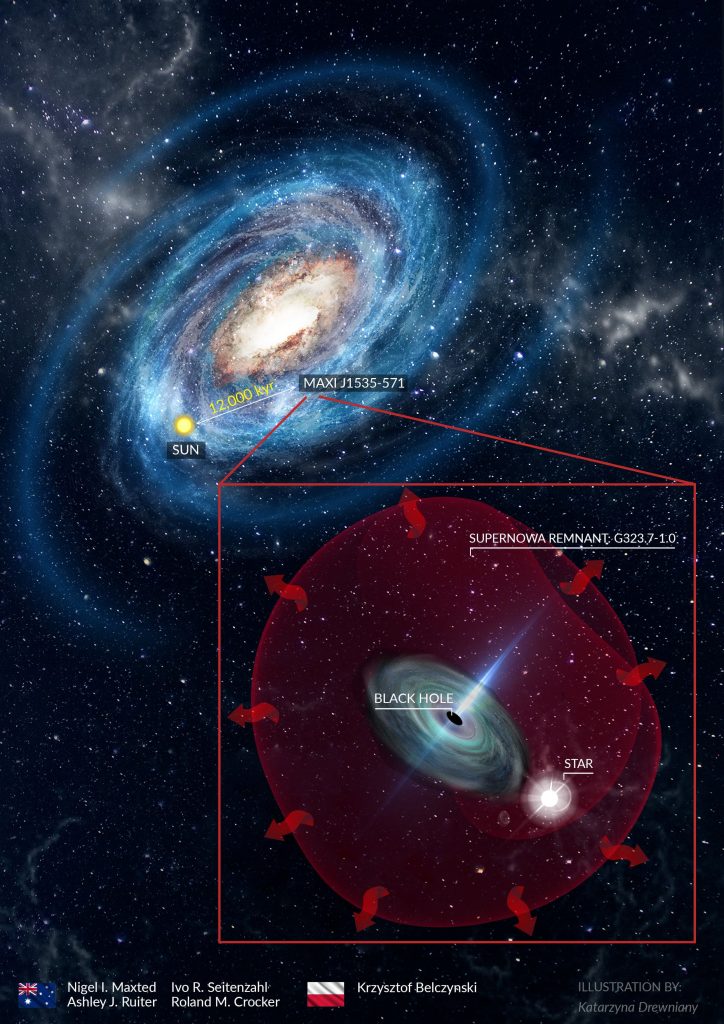
Supernovae explosions end massive stars lives. It is believed that in these explosions star cores collapse to neutron stars or black holes while outer stellar layers are ejected into cosmic void, creating spectacular expanding shells. With modern telescopes a supernova is discovered pretty much every day. Some of supernovae remnants (these expanding shells) were connected with nearby neutron stars, thus confirming stellar evolution predictions. However, until now not a single supernova was connected with black hole formation. Australian-Polish team makes such connection for a distant (12,000 light years away from Earth) supernova remnant called G323.7-1.0. It appears that within this supernova remnant there is a binary system of two objects known as MAXI J1535-571: unseen small star (maybe twice as massive as our Sun) and a medium size black hole (about 5 times more massive than Sun). The unseen star feeds black hole with matter (from its outer layers) and as this matter spirals into the black hole it radiates in X-rays that are detected by some of our space observatories. Since the black hole is almost right in the center of expanding supernova remnant, and it is at the same distance as supernova, it must be that the supernova has created this black hole in the last 10-20 thousand of years. The team estimated that probability of finding a black hole by chance in the position of this supernova is less than 1 in 1000!

Link to paper:
https://ui.adsabs.harvard.edu/abs/2020arXiv201015341M/abstract

Milky Way galaxy with marked position of an old supernova remnant (from 10-20
thousands years ago) relative to our Sun. In the expanding supernova remnant
(G323.7-1.0) a binary system (MAXI J1535-571) hosting a small star and a medium
size black hole is found. It appears that this is the first supernova known
to have formed a black hole.