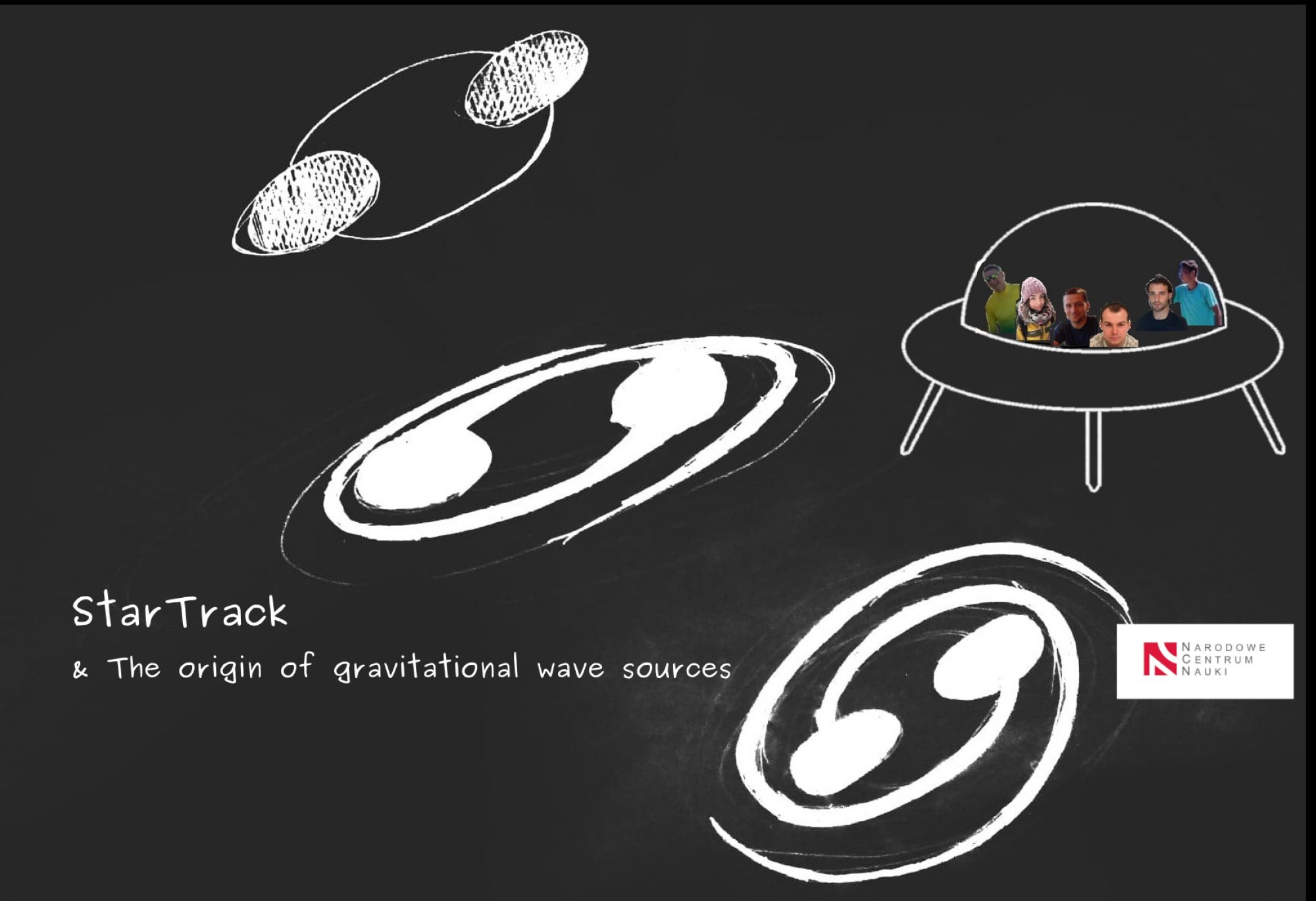
Since 2016, when the first gravitational wave detection was announced (signal GW150914, originating from the merger of two black holes with masses of ~29 and ~36 solar masses), astrophysics has opened a completely new window for observing the cosmos. Gravitational waves – predicted over 100 years ago by Einstein as an effect of his general theory of relativity – are subtle disturbances in the very fabric of spacetime, now detectable with a precision of about 1/10,000 the width of a proton by the LIGO and Virgo detectors.
To date, around 90 such signals have been recorded, dominated by merging binary black hole systems. This data provides invaluable information about the evolution of massive stars, the mechanisms behind the formation of black holes and neutron stars, and even the origin of heavy elements such as gold and platinum.
The mechanisms leading to the formation of such compact binary systems are not yet fully understood. One of the leading scenarios involves the isolated evolution of massive binary star systems – precisely the topic investigated by the research group at CAMK PAN led by Prof. Krzysztof Belczynski.
This is only the beginning. Next-generation detectors – the Einstein Telescope and Cosmic Explorer – are expected to capture signals from the early stages of the Universe’s expansion, opening up the prospect of testing theories about its evolution and the history of star formation.
Link to article: https://journals.pan.pl/Content/124728/PDF/66-68_Olejak_pol.pdf