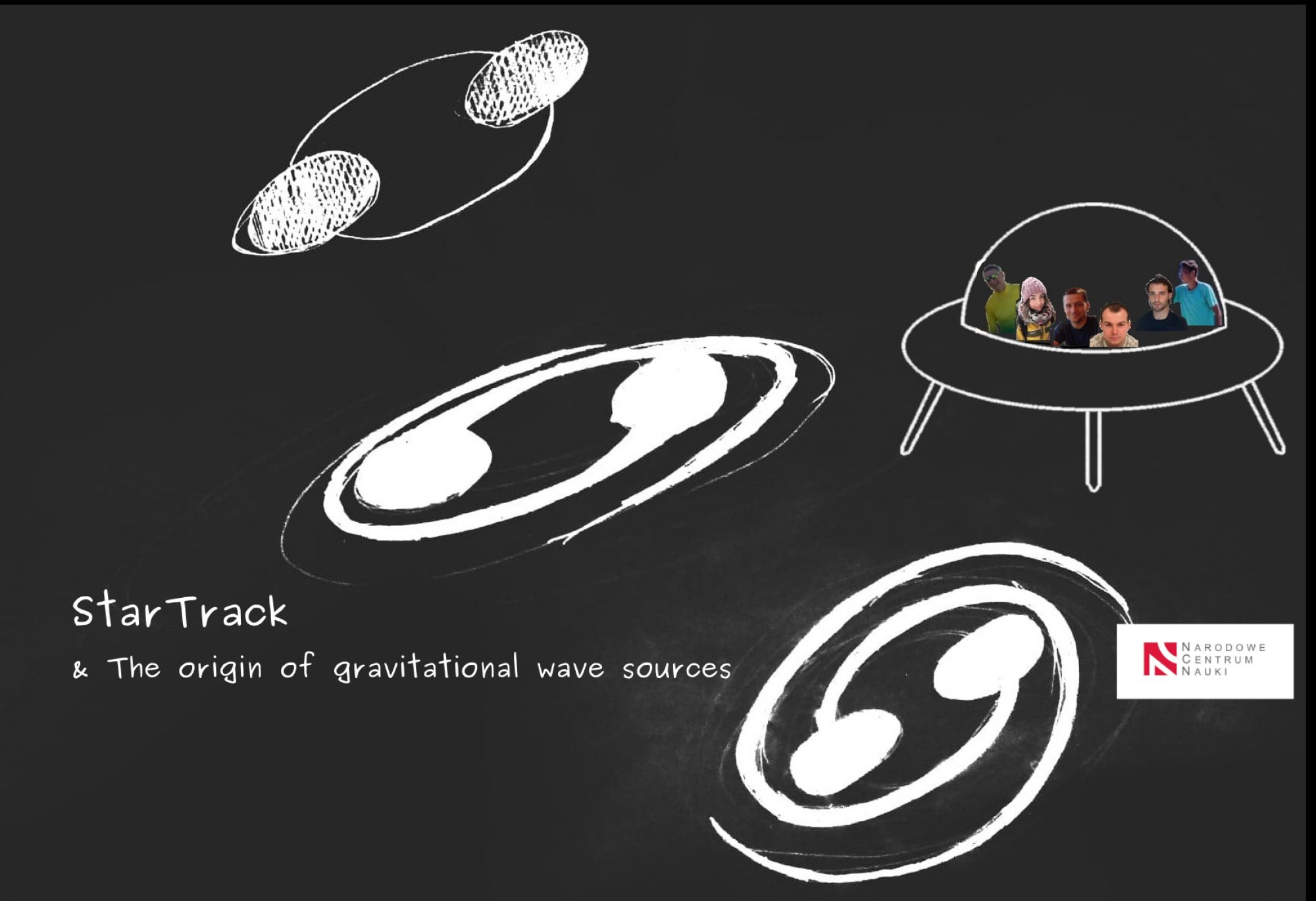
In 2010, Krzysztof Belczyński and collaborators used the StarTrack code to predict that the most likely first detections by Advanced LIGO would be mergers of binary black holes — at the time a bold theoretical claim, since no gravitational wave had ever been observed. Five years later, LIGO detected GW150914: two black holes, roughly 29 and 36 solar masses, spiralling together exactly as our models had anticipated. The 2016 Nature paper interpreting GW150914 used StarTrack simulations to characterise the progenitor stars and explicitly acknowledged the Universe@Home volunteer community whose machines ran the underlying calculations.
This is what the Universe@Home project enables in practice: the broad, systematic exploration of model parameter space that turns a theoretical hypothesis into a robust, testable prediction. As LIGO, Virgo, and KAGRA continue to accumulate detections, those same simulations — now expanded and refined — remain at the heart of our interpretation of the growing gravitational wave catalogue.
Link to the 2016 Nature paper: https://www.nature.com/articles/nature18322