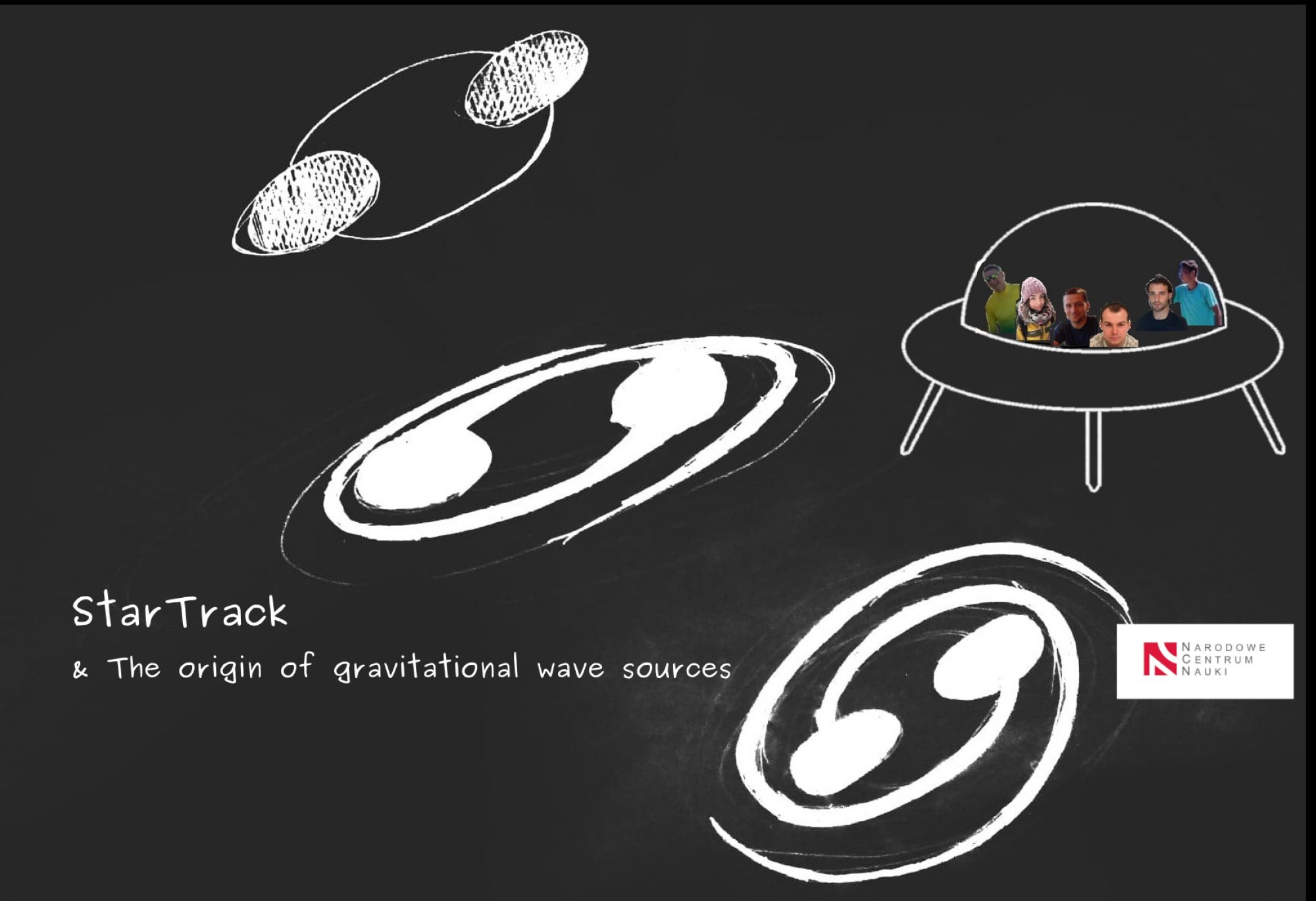
Universe@Home: A Decade of Citizen Science Comes to a Close

After nearly a decade of continuous operation, Universe@Home has announced the end of its activities. The project launched in 2015 as the first BOINC-based computing project run by a Polish scientific institution, and over the years grew to nearly 30,000 participating computers across the globe. The simulations it powered — running the StarTrack code on the idle machines of tens of thousands of volunteers — contributed to over a dozen published papers, from the landmark 2016 Nature paper on GW150914 to studies of neutron star mergers, ultraluminous X-ray sources, and, most recently, spin distributions in binary black hole populations.

The closure is inseparable from the loss of Prof. Krzysztof Belczyński, the creator of StarTrack and the scientific founder of Universe@Home, who passed away on 13 January 2024. Krzysztof dreamed up Universe@Home on the conviction that the volunteers who donate their computing time to science deserve to know what that science is — and to take pride in what it produces. The project’s full publication list is archived at universeathome.pl/universe/publications.php. The research programme continues at CAMK PAN.

Link to original post: https://universeathome.pl/universe/forum_thread.php?id=754

In Memoriam: Professor Krzysztof Belczyński (1971–2024)

It is with profound sadness that we announce the passing of Professor Krzysztof Belczyński, the founder of Startrack code and the principal investigator of this project, who left us on January 13, 2024, at the age of 52.

Professor Belczyński was the creator of the StarTrack binary population synthesis code — his large lifetime project, born in the late 1990s out of a fascination with binary stars and gravitational wave astronomy. What began as a tool to study gamma-ray bursts grew into one of the most influential frameworks in modern astrophysics, shaping our understanding of how compact objects — neutron stars and black holes — form and evolve.

Over the course of his career, Prof. Belczyński authored more than 300 publications that collectively gathered over 26,000 citations. His team created a synthetic model of the Universe enabling a global evaluation of the evolution of binary star systems as potential gravitational wave sources. His predictions about the masses and collision rates of black holes were confirmed by the historic first detection of gravitational waves in 2015 — a discovery awarded the Nobel Prize in 2017.

Professor Belczyński was associated with the Nicolaus Copernicus Astronomical Center since 1995. He obtained his Ph.D. in 2001, his habilitation in 2010, and was awarded the title of professor of physical sciences in 2014. Since 2017, he had been a professor at CAMK PAN in Warsaw.

Beyond science, Krzysztof was a man of extraordinary vitality. He blazed his own trail across the world’s most extreme mountains — the Himalayas, Karakoram, Baffin Island, Alaska, and Patagonia — and in recent years embraced kiteboarding, snowboarding, and kayaking with the same relentless energy he brought to astrophysics.

His knowledge, passion, and dedication were an inspiration to all who worked alongside him. He was colorful and courageous — always smiling, ready to fight until the end, capable of charting the most challenging paths and following them through.

He is deeply missed.

Link to official note: https://www.camk.edu.pl/en/archiwum/2024/01/14/professor-krzysztof-belczynski-has-passed-away/

Observation of Gravitational Waves

How do we study parts of the universe that remain completely invisible to traditional telescopes? In a recently published outreach article for Academia Magazine (Polish Academy of Sciences), Amedeo delved into the world of gravitational waves.

Titled “Observation of Gravitational Waves,” the piece breaks down how these subtle ripples in the fabric of spacetime—first predicted by Einstein and finally detected a century later—have revolutionized our understanding of the cosmos. From the violent collisions of black holes to the dense dances of neutron stars, Amedeo explains how “listening” to the universe allows us to probe mysteries that were once beyond our reach. It’s a fantastic deep dive into the technology and physics behind LIGO and Virgo, written for anyone curious about the next frontier of astronomy.

Link to article: https://journals.pan.pl/dlibra/show-content?id=12

Computing at Scale: Universe@Home Hits a New Record

The Universe@Home project is currently running at its highest level of activity to date, with several hundred thousand work units in progress simultaneously and around 300,000 completed per day. Each work unit is a self-contained StarTrack simulation — evolving a large sample of binary star systems through all stages of their lives and returning the final populations of compact objects for analysis. The sheer scale of this throughput is what allows us to map out broad grids of model parameters rather than testing a handful of scenarios: only by exploring many thousands of models can we properly characterise the theoretical uncertainties in binary evolution and make statistically meaningful comparisons with observations.

This kind of computing muscle — donated by tens of thousands of volunteers running BOINC on their home and office machines — is not a convenience but a scientific necessity. The merger rate predictions, spin distributions, and formation efficiency estimates that appear in our papers are only as reliable as the parameter coverage behind them. We are grateful to every volunteer who has kept their machine crunching.

Link to stats: https://universeathome.pl/universe/server_status.php

StarTrack Predicted It First

In 2010, Krzysztof Belczyński and collaborators used the StarTrack code to predict that the most likely first detections by Advanced LIGO would be mergers of binary black holes — at the time a bold theoretical claim, since no gravitational wave had ever been observed. Five years later, LIGO detected GW150914: two black holes, roughly 29 and 36 solar masses, spiralling together exactly as our models had anticipated. The 2016 Nature paper interpreting GW150914 used StarTrack simulations to characterise the progenitor stars and explicitly acknowledged the Universe@Home volunteer community whose machines ran the underlying calculations.

This is what the Universe@Home project enables in practice: the broad, systematic exploration of model parameter space that turns a theoretical hypothesis into a robust, testable prediction. As LIGO, Virgo, and KAGRA continue to accumulate detections, those same simulations — now expanded and refined — remain at the heart of our interpretation of the growing gravitational wave catalogue.

Link to the 2016 Nature paper: https://www.nature.com/articles/nature18322